 DinoDig
Parapengornis eurycaudatus
- Time
- 113.2–125.8 million years ago
- Period
- Unknown
- Known sites
- 2

Summary
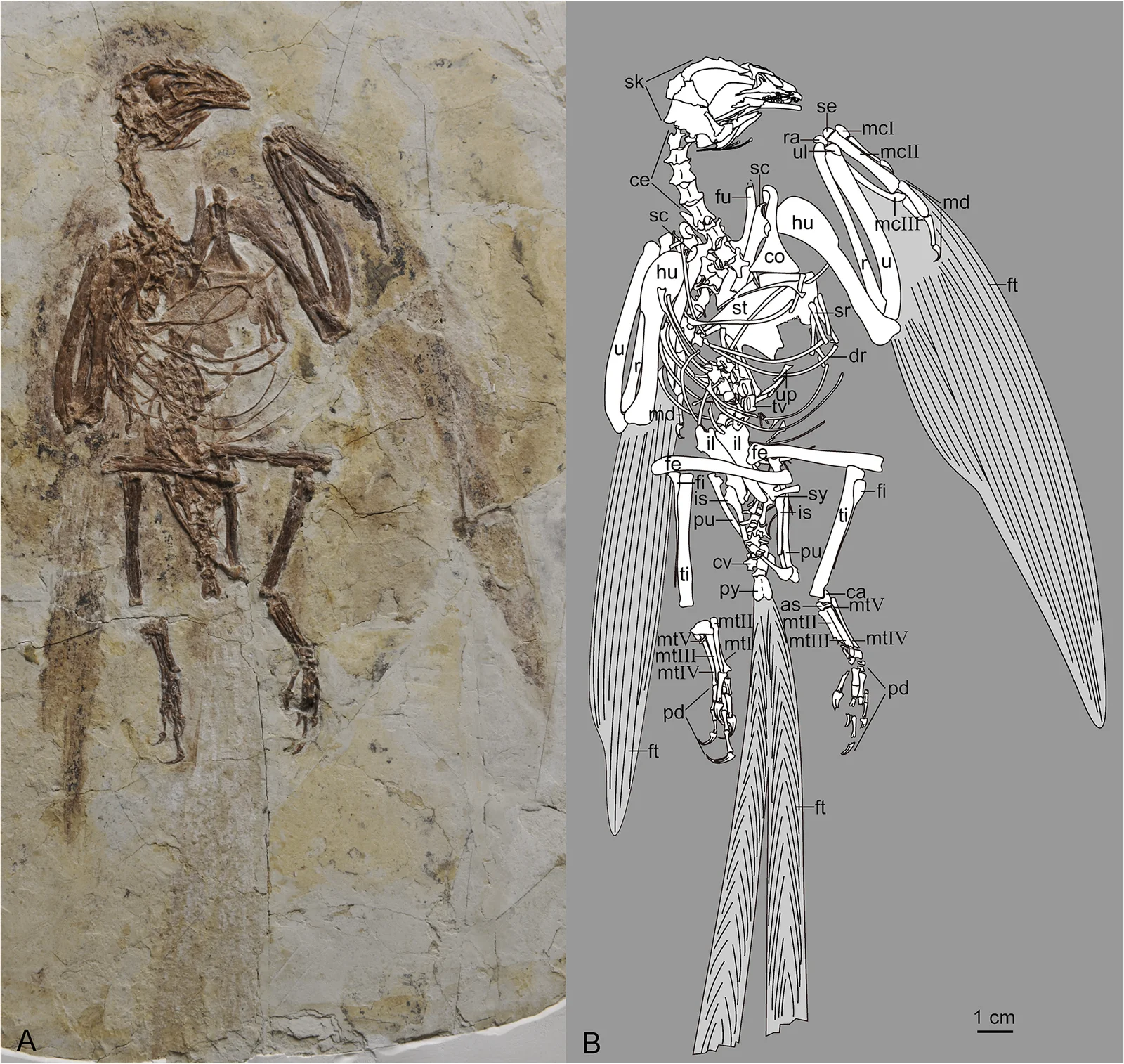
Parapengornis is an extinct genus of enantiornithean bird from the Lower Cretaceous of what is now China. The holotype specimen was discovered in the Jiufotang Formation near Lingyuan, western Liaoning province, and was catalogued as IVPP V18687. The nearly complete, articulated specimen is preserved on a slab and has impressions of pennaceous feathers. Only parts of the sternum, the left hand, and right foot are missing. In 2015, it became the basis of the new genus and species Parapengornis eurycaudatus, named by the Chinese palaeontologists Han Hu, Jingmai K. O'Connor, and Zhonghe Zhou. The generic name consists of the Latin word para and the name of the related genus Pengornis, indicating their close relationship. The name Pengornis is itself derived from "Peng", a mythological bird from Chinese folklore, and ornis, which means bird in Greek. The specific name is derived from the Latin words eury, meaning broad, and caudatus, meaning tail, in reference to the broad and expanded pygostyle. A nearly complete specimen formerly assigned to Pengornis was also reassigned to Parapengornis by these authors.
Source: Wikipedia - Parapengornis
Known Sites
Loading known-site map...